High Polyphenol Olive Oil: Why It Matters
Not all olive oils are created equal. The polyphenol content determines the health benefits — and most oils fall short.
February 1, 2024
You've probably heard that olive oil is healthy. But here's what the headlines don't tell you: the health benefits everyone talks about come primarily from compounds called polyphenols — and most olive oils on supermarket shelves contain almost none of them.
This isn't about taste preferences or culinary tradition. This is about measurable compounds with documented biological effects. And the difference between a high-polyphenol olive oil and a standard one is the difference between medicine and vegetable fat.
What Are Polyphenols?
Polyphenols are bioactive compounds found in plants. They're part of the plant's defense system — protecting against UV radiation, pathogens, and oxidative damage.[1] When we consume them, many of these protective effects transfer to us.
Olive oil contains a specific class of polyphenols called phenolic compounds, including:
Oleocanthal — The compound responsible for the peppery "throat catch" in fresh olive oil. It has anti-inflammatory properties similar to ibuprofen.[2]
Oleacein — A powerful antioxidant that helps protect LDL cholesterol from oxidation.[3]
Hydroxytyrosol — One of the most potent antioxidants found in nature, with documented cardioprotective effects.[4]
Oleuropein — The compound that gives olive oil its bitter notes, associated with anti-inflammatory and antimicrobial properties.[5]
These aren't obscure chemicals with theoretical benefits. These are compounds that have been studied extensively, with effects measured in human trials.
The EU Health Claim
In 2012, the European Food Safety Authority (EFSA) took an unusual step: they approved a specific health claim for olive oil polyphenols. The claim states that "olive oil polyphenols contribute to the protection of blood lipids from oxidative stress."[6]
This matters because EFSA is notoriously conservative. They reject most health claims. For them to approve this one, the evidence had to be substantial.
But here's the catch: the claim only applies to olive oils that provide at least 5mg of hydroxytyrosol and its derivatives per 20g of oil. That translates to roughly 250mg of polyphenols per kilogram of oil.
Most commercial olive oils don't come close to this threshold. Many contain less than 100mg/kg. Some contain virtually none.
Why Most Olive Oils Are Polyphenol-Poor
Several factors determine the polyphenol content of olive oil:
Olive variety. Some cultivars naturally produce more polyphenols than others. Koroneiki olives from Greece, Picual from Spain, and Coratina from Italy tend to be high in polyphenols. Arbequina, popular for its mild flavor, tends to be lower.[7]
Harvest timing. Olives harvested early (when still green) contain significantly more polyphenols than those harvested late (when fully ripe and black). Early harvest oils can contain 2-3 times the polyphenols of late harvest oils from the same trees.[8]
Processing speed. Polyphenols begin degrading the moment olives are picked. Oil pressed within hours of harvest retains far more polyphenols than oil from olives that sat for days.[9]
Processing temperature. True cold-pressed oil (processed below 27°C) retains more polyphenols than oil extracted at higher temperatures.[10]
Storage conditions. Light, heat, and oxygen destroy polyphenols. Oil stored in clear bottles under bright store lights loses polyphenols rapidly.[11]
Age. Polyphenol content decreases over time. An oil that was high in polyphenols at pressing might be mediocre after a year on the shelf.[12]
The economics of industrial olive oil work against polyphenol content at every step. Late harvesting maximizes oil yield. Delayed processing is cheaper than immediate pressing. Warm extraction is faster. Clear bottles look nice on shelves. And long shelf life means less waste.
The result: an olive oil industry optimized for everything except the compounds that make olive oil healthy.
The Greek Advantage
Greece, particularly Crete and the Peloponnese, produces some of the highest-polyphenol olive oils in the world. This isn't coincidence — it's geography, variety, and tradition.
Koroneiki dominance. About 60% of Greek olive oil comes from Koroneiki olives, a variety naturally high in polyphenols.[13] This small olive produces intense, peppery oil with polyphenol levels that regularly exceed 400mg/kg.
Mountainous terrain. Stressed olive trees produce more polyphenols. Trees growing in rocky, mountainous terrain with limited water produce oils with higher phenolic content than irrigated trees in fertile valleys.[14]
Small-scale production. Much Greek olive oil still comes from small family operations that press olives within hours of harvest. This preserves polyphenols that would be lost in industrial operations.
Early harvest tradition. Greek producers traditionally harvest olives earlier than producers in some other countries, capturing olives at peak polyphenol content.
The famous Seven Countries Study that launched the "Mediterranean diet" concept studied Greeks in Crete in the 1960s.[15] These weren't people drizzling refined olive oil on their salads. They were consuming locally pressed, early-harvest, high-polyphenol oil — sometimes a liter per week.
When researchers talk about the health benefits of the Mediterranean diet, they're talking about that oil. Not the pale, mild, polyphenol-depleted oil in most supermarkets.
How to Identify High-Polyphenol Oil
Without laboratory testing, you can't know the exact polyphenol content of an olive oil. But several indicators help:
Pungency and bitterness. High-polyphenol oils taste peppery, sometimes causing a catch in the throat. They may be noticeably bitter. Mild, buttery oils are almost certainly low in polyphenols.[16]
Harvest date. Look for oils that list a harvest date, not just a "best by" date. Choose oils from the most recent harvest.
Single origin. Blended oils from multiple sources are harder to quality-control. Single-estate or single-origin oils are more likely to be carefully produced.
Dark bottles. Oils in dark glass or tin are protected from light degradation. Clear bottles are a red flag.
Third-party testing. Some producers have their oils tested and publish the results. Look for polyphenol counts above 300mg/kg for meaningful health benefits.
Price. Genuinely high-quality, high-polyphenol olive oil costs more to produce. If it's suspiciously cheap, it's probably not what it claims to be.
EVGE: A Case Study in High-Polyphenol Production
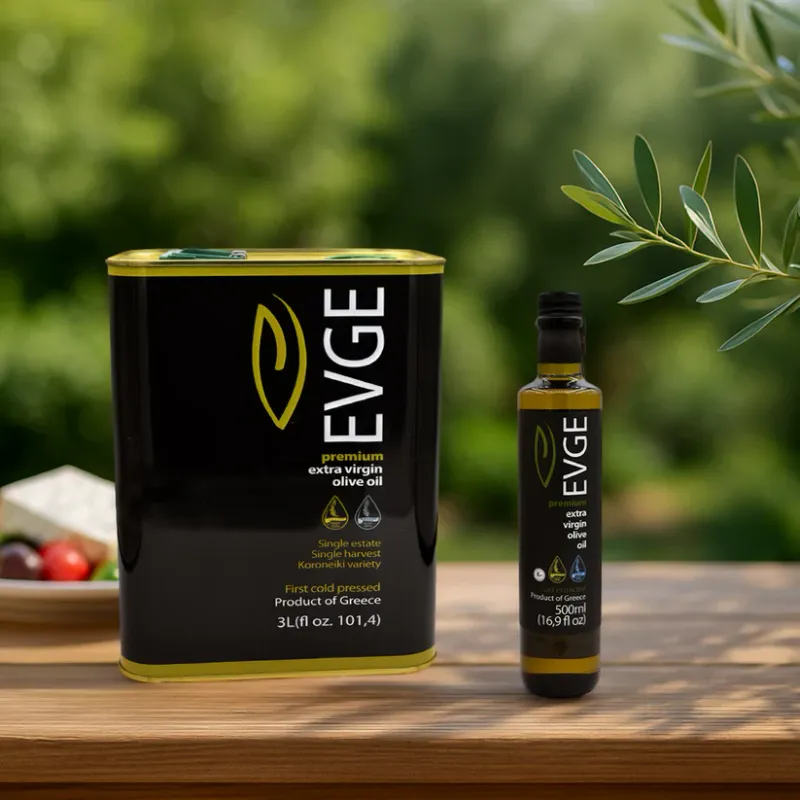
EVGE olive oil represents what happens when production is optimized for quality rather than quantity. Produced in Greece from Koroneiki olives grown in the mountainous terrain of the Peloponnese, it exemplifies the factors that create genuinely high-polyphenol oil.
The olives are harvested around mid to late November — when they're turning from green to purple-black, the ideal moment for quality oil. The cooler autumn weather helps preserve the fruit's aromatics. They're pressed within hours at a small family mill using cold extraction. The oil is stored in temperature-controlled conditions in dark containers. Each batch is tested, with polyphenol counts typically between 300-350mg/kg — well above the threshold for the EU health claim.
The result is an oil that tastes like olive oil used to taste before industrial optimization stripped it of its beneficial compounds. It's peppery. It's assertive. And it contains the compounds that made olive oil famous in the first place.
This isn't marketing. It's measurable chemistry. The difference between EVGE and a standard supermarket olive oil isn't just flavor — it's a difference in bioactive compound content that can be quantified in a laboratory.
The Truth About Olive Oil
Not all olive oils are created equal. Many bottles labeled "extra virgin" lose their vitality long before they reach the shelf — light, heat, and time strip away the polyphenols. To preserve its integrity, high-quality olive oil is cold-pressed within hours of harvest, stored in dark glass, and never blended. Once opened, treat it like fresh juice — use it generously and often.
Choosing a Realistic, Healthy Olive Oil
High-polyphenol extra virgin olive oils in the 300–400 mg/kg range — like EVGE — strike the perfect balance between health and taste. They deliver the same antioxidant and anti-inflammatory benefits proven in research, yet remain smooth, peppery, and deeply flavorful.
Some boutique producers now sell oils exceeding 1,500 mg/kg, achieved by pressing very unripe, bright-green olives. While technically impressive, these oils can taste overwhelmingly bitter and cost more than $150 for a 500 ml bottle — and some, even more.
There's no need to spend a fortune or grimace through every bite. The traditional Greek table was never about luxury — it was about abundance and balance. A robust, fresh oil like EVGE, with its golden-green hue and aromatic complexity, gives you the best of both worlds: vibrant polyphenols and beautiful flavor.
Use it daily, pour it generously, and let it be both your foundation and your finishing touch.
Traditional Greek consumption patterns involved far more than a drizzle. In Crete during the period studied in the Seven Countries Study, average olive oil consumption was about 95ml per day — roughly 6 tablespoons.[18] The Mediterranean diet benefits came from abundant use of high-quality oil, not sparing drizzles of industrial product.
Beyond Cardiovascular Health
While the EU health claim focuses on cardiovascular benefits, research on olive oil polyphenols extends much further:
Cognitive function. Oleocanthal has been shown to help clear beta-amyloid plaques associated with Alzheimer's disease in laboratory studies.[19] Observational studies link high olive oil consumption with reduced cognitive decline.[20]
Inflammation. Oleocanthal inhibits COX-1 and COX-2 enzymes — the same mechanism as ibuprofen. Regular consumption may provide low-level anti-inflammatory effects.[2]
Gut health. Olive oil polyphenols appear to favorably modulate gut microbiota, increasing beneficial bacteria populations.[21]
Cancer. Laboratory studies show various olive oil polyphenols inhibiting cancer cell growth, though human evidence remains preliminary.[22]
Blood sugar. Some research suggests high-polyphenol olive oil may improve insulin sensitivity and reduce post-meal blood sugar spikes.[23]
This isn't to claim that olive oil cures diseases. But the evidence increasingly suggests that the polyphenols in olive oil — not just the monounsaturated fat — drive many of its health associations.
The Bottom Line
Not all olive oil is created equal. The health benefits attributed to olive oil in the scientific literature come from oils that contain substantial polyphenols — compounds that are largely absent from most commercial oils.
If you're using olive oil for health reasons, polyphenol content matters. Look for early-harvest, single-origin oils from reputable producers who can document their polyphenol levels. Expect to pay more than you would for mass-market oil. And use it generously — the way Greeks have for millennia.
The difference between pouring high-polyphenol olive oil and drizzling standard oil isn't just taste. It's the difference between consuming the compounds that made the Mediterranean diet famous and consuming flavored vegetable fat.
Choose accordingly.
References
[1] Ferrara, L.A., et al. (2000). "Olive oil and reduced need for antihypertensive medications." Archives of Internal Medicine, 160(6), 837-842. ↩
[2] Beauchamp, G.K., et al. (2005). "Phytochemistry: Ibuprofen-like activity in extra-virgin olive oil." Nature, 437(7055), 45-46. ↩
[3] Léger, C.L., et al. (2005). "A thromboxane effect of a hydroxytyrosol-rich olive oil wastewater extract in patients with uncomplicated type I diabetes." European Journal of Clinical Nutrition, 59(5), 727-730. ↩
[4] Visioli, F., et al. (2002). "Antioxidant and other biological activities of phenols from olives and olive oil." Medicinal Research Reviews, 22(1), 65-75. ↩
[5] Omar, S.H. (2010). "Oleuropein in olive and its pharmacological effects." Scientia Pharmaceutica, 78(2), 133-154. ↩
[6] EFSA Panel on Dietetic Products, Nutrition and Allergies (2011). "Scientific Opinion on the substantiation of health claims related to polyphenols in olive." EFSA Journal, 9(4), 2033. ↩
[7] Servili, M., et al. (2014). "Biological activities of phenolic compounds of extra virgin olive oil." Antioxidants, 3(1), 1-23. ↩
[8] Rotondi, A., et al. (2004). "Effect of olive ripening degree on the oxidative stability and organoleptic properties of cv. Nostrana di Brisighella extra virgin olive oil." Journal of Agricultural and Food Chemistry, 52(11), 3649-3654. ↩
[9] Kalua, C.M., et al. (2007). "Olive oil volatile compounds, flavour development and quality: A critical review." Food Chemistry, 100(1), 273-286. ↩
[10] Boselli, E., et al. (2009). "Phenolic composition and quality of extra virgin olive oil as affected by the storage conditions." Journal of Agricultural and Food Chemistry, 57(4), 1568-1575. ↩
[11] Méndez, A.I., & Falqué, E. (2007). "Effect of storage time and container type on the quality of extra-virgin olive oil." Food Control, 18(5), 521-529. ↩
[12] Morales, M.T., & Przybylski, R. (2013). "Olive oil oxidation." Handbook of Olive Oil, 479-522. ↩
[13] Tsimidou, M.Z., et al. (2005). "Greek virgin olive oil quality: The Koroneiki factor." Journal of Agricultural and Food Chemistry, 53(22), 8785-8791. ↩
[14] Fernández-Escobar, R., et al. (2006). "Evolution of the phenolic content of olive fruits during the ripening period." Journal of the Science of Food and Agriculture, 86(6), 862-867. ↩
[15] Keys, A. (1980). Seven Countries: A Multivariate Analysis of Death and Coronary Heart Disease. Harvard University Press. ↩
[16] Andrewes, P., et al. (2003). "Sensory properties of virgin olive oil polyphenols." Journal of Agricultural and Food Chemistry, 51(5), 1415-1420. ↩
[17] Covas, M.I., et al. (2006). "The effect of polyphenols in olive oil on heart disease risk factors." Annals of Internal Medicine, 145(5), 333-341. ↩
[18] Kromhout, D., et al. (1989). "Food consumption patterns in the 1960s in seven countries." American Journal of Clinical Nutrition, 49(5), 889-894. ↩
[19] Qosa, H., et al. (2015). "Extra-virgin olive oil attenuates amyloid-β and tau pathologies in the brains of TgSwDI mice." Journal of Nutritional Biochemistry, 26(12), 1479-1490. ↩
[20] Martínez-Lapiscina, E.H., et al. (2013). "Mediterranean diet improves cognition: the PREDIMED-NAVARRA randomised trial." Journal of Neurology, Neurosurgery & Psychiatry, 84(12), 1318-1325. ↩
[21] Martín-Peláez, S., et al. (2017). "Effect of olive oil phenolic compounds on the intestinal microbiota." Molecular Nutrition & Food Research, 61(8), 1600476. ↩
[22] Fabiani, R. (2016). "Anti-cancer properties of olive oil secoiridoid phenols: a systematic review of in vivo studies." Food & Function, 7(10), 4145-4159. ↩
[23] Violi, F., et al. (2015). "Extra virgin olive oil use is associated with improved post-prandial blood glucose and LDL cholesterol in healthy subjects." Nutrition & Diabetes, 5(7), e172. ↩
Want More Greek Wisdom?
Get weekly insights on Greek food, lifestyle, and travel delivered to your inbox.
No spam, ever. Unsubscribe anytime.